


As urbanization accelerates and urban renewal projects multiply, construction waste generation continues to climb. In China alone, annual construction waste output reaches approximately 3.55 billion tonnes, accounting for over 40% of total municipal solid waste. Construction waste, however, differs fundamentally from natural ore: it is complex in composition, scattered in distribution, limited in volume per site, and highly variable in particle size and strength. These characteristics create significant bottlenecks for traditional stationary crushing lines, while mobile crushing plants are becoming an increasingly suitable solution thanks to their inherent flexibility.
1. Material Characteristics of Construction Waste Determine the Crushing Approach

To understand why mobile crushing plants fit construction waste, the material characteristics must first be examined:
- Composition diversity: Typical construction waste contains concrete chunks (40%-60%), brick and tile fragments (20%-30%), asphalt pieces (5%-15%), rebar and steel mesh (2%-5%), wood and plastic (1%-3%), and glass and ceramics (1%-2%) - Strength variability: Concrete compressive strength ranges from C20 to C60, brick fragments measure only 5-20 MPa, and asphalt softens and sticks at high temperatures - Embedded steel: Demolished concrete often contains rebar, wire mesh, and other metal objects that cause jamming and excessive wear in crushers - Moisture and clay fluctuation: Construction waste at demolition sites is exposed to the elements. During rainy seasons, moisture content can reach 8%-12%, with clay content of 5%-15% - Low bulk density: Construction waste bulk density is approximately 1.2-1.6 t/m3, which is 30%-40% lower than natural ore (1.8-2.5 t/m3), meaning the same volume yields less processed material
| Component | Proportion | Impact on Crushing |
| Concrete chunks | 40%-60% | Primary crushing target, variable strength |
| Brick and tile | 20%-30% | Low strength, prone to over-crushing |
| Asphalt pieces | 5%-15% | Sticky at high temperatures, needs separate handling |
| Rebar and steel | 2%-5% | Requires magnetic separation, causes jamming |
| Wood and plastic | 1%-3% | Light material, separated by air or water |
| Glass and ceramics | 1%-2% | Brittle, fractures easily |
These characteristics demand crushing equipment with strong adaptability: the ability to process mixed materials, handle metal contaminants, and maintain stable operation under fluctuating moisture. Mobile crushing plants, with their ability to flexibly combine different crushing stages and multi-level screening, adapt more easily to these changing conditions than stationary lines.
2. Five Key Advantages of Mobile Crushing Plants Over Stationary Lines
Construction waste originates at urban demolition sites, while stationary crushing plants are typically located at city outskirts or in suburban areas. Transporting waste from the demolition site to a stationary plant often covers 20-80 km, at a cost of 15-30 RMB per tonne. A mobile crushing plant can drive directly into the demolition site and crush at the source, converting waste into recycled aggregate before transport. Since crushing reduces volume by 50%-60%, the total transport volume drops significantly, cutting overall logistics costs by over 40%.
A stationary crushing line requires 3-6 months from site preparation, foundation pouring, and equipment installation through commissioning. A mobile crushing plant requires no concrete foundation — it only needs equipment positioning, conveyor connection, and electrical wiring, reaching production in 3-7 days. For demolition projects with tight schedules, this time advantage means waste can be processed within the project window without hauling to temporary stockpiles.
Construction waste generation is inherently scattered — a city may have dozens of demolition sites running simultaneously, each producing from a few thousand to hundreds of thousands of tonnes. A mobile crushing plant can process material at one site, then drive or be transported by flatbed truck to the next. Tyre-type mobile crushers travel at up to 30 km/h on public roads, while crawler-type units move more slowly but can climb slopes and navigate rough terrain. The two travel modes suit different relocation needs.
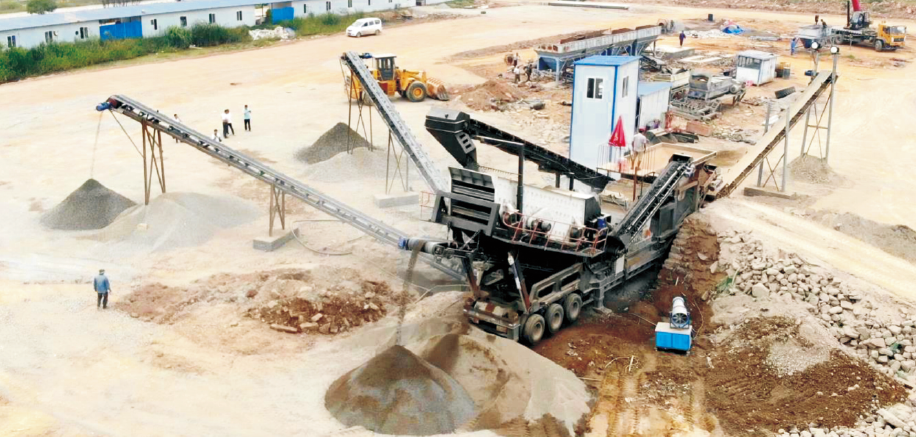
Mobile crushing plants use a modular design that can be flexibly combined based on waste composition and product requirements:
- Primary crushing: VPE Series tyre-type mobile jaw crusher plant, accepting feed up to 500-800 mm, reducing large concrete and brick chunks to below 100 mm - Secondary crushing: VPF Series tyre-type mobile impact crusher plant or VPC Series tyre-type mobile cone crusher plant, further reducing material to below 40 mm - Screening: vibrating screen configured in VPM-3 combined mobile plant, separating recycled aggregate into 0-5 mm, 5-10 mm, 10-20 mm, and 20-40 mm fractions - Auxiliary equipment: Magnetic separator (for rebar removal), air sorter or washing equipment (for light material and clay separation)
When waste is predominantly concrete, a VPE jaw crusher + VPF impact crusher + magnetic separator combination works well. When brick and tile dominate, a simpler VPE jaw crusher + vibrating screen single-stage configuration may suffice. This flexibility is difficult to achieve with a stationary line.
Urban demolition sites are often surrounded by residential or commercial areas that are highly sensitive to dust and noise. Mobile crushing plants offer environmental advantages over stationary lines:
- Equipped with spray dust suppression and enclosed crushing chambers, dust emissions can be controlled below 80 mg/m3 - Rubber vibration-damping pads under the equipment reduce vibration noise by 5-8 dB compared to stationary equipment - Soundproof enclosures can bring noise levels to under 75 dB at 1 meter distance - No blasting required, avoiding vibration impact on nearby structures
3. Tyre-Type vs. Crawler-Type Mobile Crushing Plants
Mobile crushing plants are divided into tyre-type and crawler-type by travel mode. Selection depends on project characteristics:
- Travel: Towed or self-propelled, road speed 20-30 km/h - Applicable scenarios: Urban road relocation, frequent moves between sites, projects requiring road registration - Advantages: Fast relocation, low transport cost, no special trailer needed for short distances - Limitations: Requires relatively flat ground, limited climbing ability (typically under 15 degrees) - Vanguard Machinery representative models: VPE Series tyre-type mobile jaw crusher plant, VPF Series tyre-type mobile impact crusher plant
- Travel: Hydraulic crawler drive, speed typically 0.5-2 km/h - Applicable scenarios: On-site movement within large demolition areas, mountainous or uneven terrain, long-term single-site operation - Advantages: Low ground pressure (0.05-0.1 MPa), strong climbing ability (up to 25 degrees), in-place turning - Limitations: Requires flatbed transport for relocation, priced 15%-25% higher than comparable tyre-type units - Vanguard Machinery representative models: C96/C106/C116 crawler-type mobile jaw crusher plant, LA Series crawler-type mobile cone crusher plant
| Parameter | Tyre-Type (VPE/VPF Series) | Crawler-Type (C96/C106/C116/LA Series) |
| Travel speed | 20-30 km/h | 0.5-2 km/h |
| Climbing ability | Approx. 15 degrees | Approx. 25 degrees |
| Ground pressure | Higher | 0.05-0.1 MPa |
| Relocation method | Self-driven/towed | Flatbed transport |
| Suitable terrain | Flat ground | Uneven ground |
| Price | Baseline | 15%-25% higher |
Selection guidance: If projects are scattered across different urban areas with inter-site distances over 10 km, tyre-type is recommended. If work is concentrated at a large demolition site (such as a complete old factory complex) with complex terrain, crawler-type is the better choice. For comprehensive projects, a VPE Series tyre-type primary crushing plant can serve as the main unit, supplemented by an LA Series crawler-type screening plant for flexible positioning.
4. Applications and Quality Requirements for Recycled Aggregate
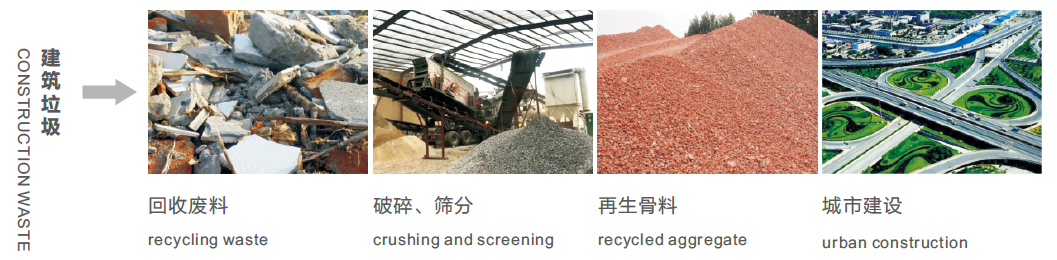
The ultimate goal of processing construction waste with a mobile crushing plant is to produce usable recycled aggregate. The main application directions include:
Recycled aggregate is most maturely applied in road engineering. Continuously graded 0-40 mm recycled aggregate can replace natural crushed stone in road subbase and base courses. Per industry standards, the crushing value of recycled aggregate should not exceed 30%, flakiness should be under 15%, and clay content under 3%. Recycled concrete aggregate processed through a mobile crushing plant typically achieves a crushing value of 22%-28%, fully meeting road engineering requirements.
0-5 mm recycled fine aggregate can produce permeable bricks, curb stones, and non-load-bearing blocks. Recycled aggregate bricks achieve compressive strength of MU15-MU20 with water absorption below 8%, meeting pedestrian and plaza paving requirements. A 200 tph mobile crushing plant can produce approximately 800 tonnes of fine aggregate per day, enough for 20,000-30,000 permeable bricks.
In concrete grades C30 and below, recycled coarse aggregate can replace 30%-50% of natural aggregate. Recycled aggregate concrete achieves 85%-95% of the 28-day compressive strength of natural aggregate concrete, suitable for blinding concrete, pavement concrete, and non-structural elements. Note that recycled aggregate has higher water absorption (5%-10%), so mix designs must adjust water content accordingly.
Unscreened mixed recycled aggregate (0-100 mm) can be directly used for foundation pit backfill, site grading, and roadbed filling. This is the lowest-cost utilization method, with processing costs of only 10-15 RMB per tonne, saving over 60% compared to off-site landfill disposal (transport + tipping fees of 30-50 RMB per tonne).
5. Technical Features of Vanguard Machinery Mobile Crushing Plants
Vanguard Machinery has accumulated extensive engineering experience in mobile crushing plants, with equipment featuring the following technical characteristics:
- Integrated feeding system: The ZSW Series vibrating feeder bottom is equipped with pre-screening grizzly bars that screen out undersized material before it enters the crusher, reducing crusher load and boosting overall throughput by 15%-20% - Metal contaminant separation: An electromagnetic separator on the crusher discharge belt effectively removes rebar, wire, and other metal from construction waste, protecting downstream equipment - Intelligent control system: A PLC control system monitors crusher load, conveyor flow, and screen amplitude in real time, automatically adjusting feed rate to keep the equipment at optimal operating conditions - Quick-change design: Conveyors, screen meshes, and wear parts use quick-disassembly structures. On-site screen mesh replacement takes about 30 minutes, blow bar replacement about 2 hours, significantly reducing downtime - Integrated dust control: Spray systems at feed and discharge openings, dust collection hoods and bag filters at key dust points, meeting urban construction environmental requirements
6. Economic Analysis
Consider a mid-sized urban demolition project: 100,000 tonnes of construction waste, 6-month processing period.
| Cost Item | Calculation | Amount (10k RMB) |
| Transport | 100,000 t x 25 RMB/t | 250 |
| Crushing fee | 100,000 t x 18 RMB/t | 180 |
| Return transport of recycled aggregate | 50,000 t x 20 RMB/t | 100 |
| Total cost | 530 |
| Cost Item | Calculation | Amount (10k RMB) |
| Equipment rental | 6 months x 150,000 RMB/month | 90 |
| Operating cost (electricity + labor + diesel) | 6 months x 80,000 RMB/month | 48 |
| Recycled aggregate transport | 50,000 t x 20 RMB/t | 100 |
| Total cost | 238 |
The mobile plant option saves approximately 2.92 million RMB — a 55% cost reduction. Additionally, recycled aggregate sales revenue (approximately 50,000 t x 40 RMB/t = 2.0 million RMB) can further offset processing costs, enabling profitable construction waste operations.
Frequently Asked Questions
Vanguard Machinery mobile crushing plants cover a capacity range of 50-500 tph. A single VPE Series tyre-type jaw crusher plant typically processes concrete at 100-300 tph. Adding a VPF Series impact crusher secondary plant and a vibrating screen plant brings the line capacity to 200-400 tph. Actual capacity depends on waste composition, feed size, and moisture content. Material sampling and testing during the design phase is recommended.
Operating a mobile crushing plant at an urban site typically requires: construction waste disposal approval, construction noise emission permit, and dust emission declaration. Because mobile plants require no permanent structures, no land-use change or construction permit is needed, simplifying the approval process by over 50% compared to stationary plants. Specific requirements vary by city. Vanguard Machinery can provide technical specification documents to assist with applications.
No. Vanguard Machinery jaw crushers and impact crushers use high manganese steel wear parts that withstand rebar impact and friction. More importantly, mobile plants are equipped with electromagnetic separators at the crusher discharge that automatically separate rebar and metal fragments into a dedicated collection area. A manual picking station above the feed opening allows workers to remove large steel bundles and conduits before crushing, providing additional equipment protection.
It depends on the project. Tyre-type plants suit frequent relocation between multiple urban demolition sites, with fast road travel and low transport costs. Crawler-type plants suit movement within a single large demolition site, with low ground pressure and the ability to work on soft or uneven ground. Most urban construction waste projects choose tyre-type plants due to high relocation frequency and good road conditions. For large-scale projects like complete factory complex demolition, crawler-type plants are more advantageous.
Conclusion
Construction waste volumes keep growing, environmental regulations are tightening, and the recycled aggregate market is maturing — these three forces combined have elevated mobile crushing plants from an optional approach to the optimal solution. Vanguard Machinery's mobile crushing plant product line covers both tyre-type (VPE/VPF/VPC Series) and crawler-type (C96/C106/C116/LA Series) series, configurable with jaw crushers, impact crushers, cone crushers, and vibrating screens to meet construction waste processing needs of different scales and compositions. If you are planning a construction waste recycling project, contact Vanguard Machinery for a free material analysis and solution design consultation.

