


- To build a 150 TPH fixed crushing plant in Ecuador for gold ore and hard-rock aggregate, run gold ore and hard-rock aggregate with jaw primary plus cone crusher secondary and closed-circuit screening; add a VSI for cubical aggregate or manufactured sand.- There is no one-size-fits-all setup; read the feed hardness, the product grades and whether site and power are ready first, since these drive every model choice downstream.- Andean mountains meet tropics; mines sit in hills with limited roads and power, so mobile plants phasing along the vein are more flexible.- Chinese-made hard-rock closed-circuit equipment gives strong value and predictable spare parts, a common pick here; a fixed line fits long tenure, flat ground and stable power.
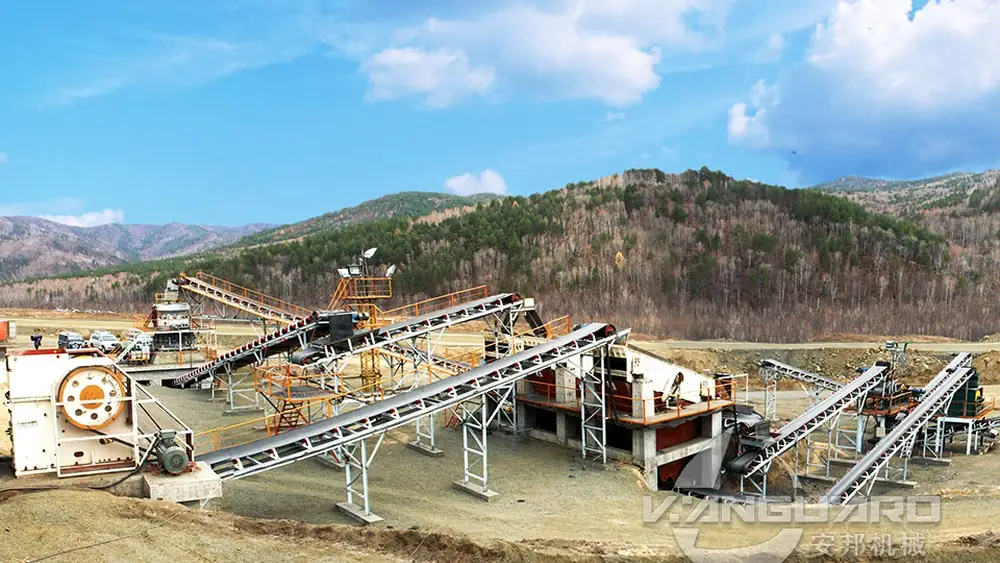
Stone and site conditions in Ecuador
- Gold-ore development and road infrastructure lift hard-rock crushing and aggregate demand; hill projects prefer relocatable equipment. - Andean mountains meet tropics; mines sit in hills with limited roads and power, so mobile plants phasing along the vein are more flexible. - 0-5, 5-10, 10-20, 20-40mm grades; some ore needs 0-12mm mill feed.
How to settle the fixed-line configuration
- Start with the rock: gold ore and hard-rock aggregate takes jaw plus cone crusher; medium-hard rock may use impact for shaping. - Then the product: 0-5, 5-10, 10-20, 20-40mm grades; some ore needs 0-12mm mill feed. closed screening holds gradation; add a VSI for manufactured sand. - Finally the site: a 10-plus-year license, flat ground and stable power favor a fixed line; otherwise a mobile plant is the more flexible pick.
| What to decide first | What it sets | Common Ecuador answer |
| Feed hardness | Primary and secondary | gold ore and hard-rock aggregate -> jaw plus cone crusher |
| Product grades | Screen decks, sand? | multi-grade plus sand |
| Site and tenure | Mobile or fixed | phased / remote -> mobile |
Recommended fixed process: hard-rock jaw-plus-cone closed circuit
- Primary jaw crusher 6CX106 takes the feed down to below 150-200mm; secondary cone crusher CS160 does mid crushing.- Tertiary as needed: for shape and sand add a VSI (5X series); for aggregate only use the closed inclined screen.- Closed-circuit screening returns oversize, keeping flat-elongated content low — the key to stable 150 TPH.
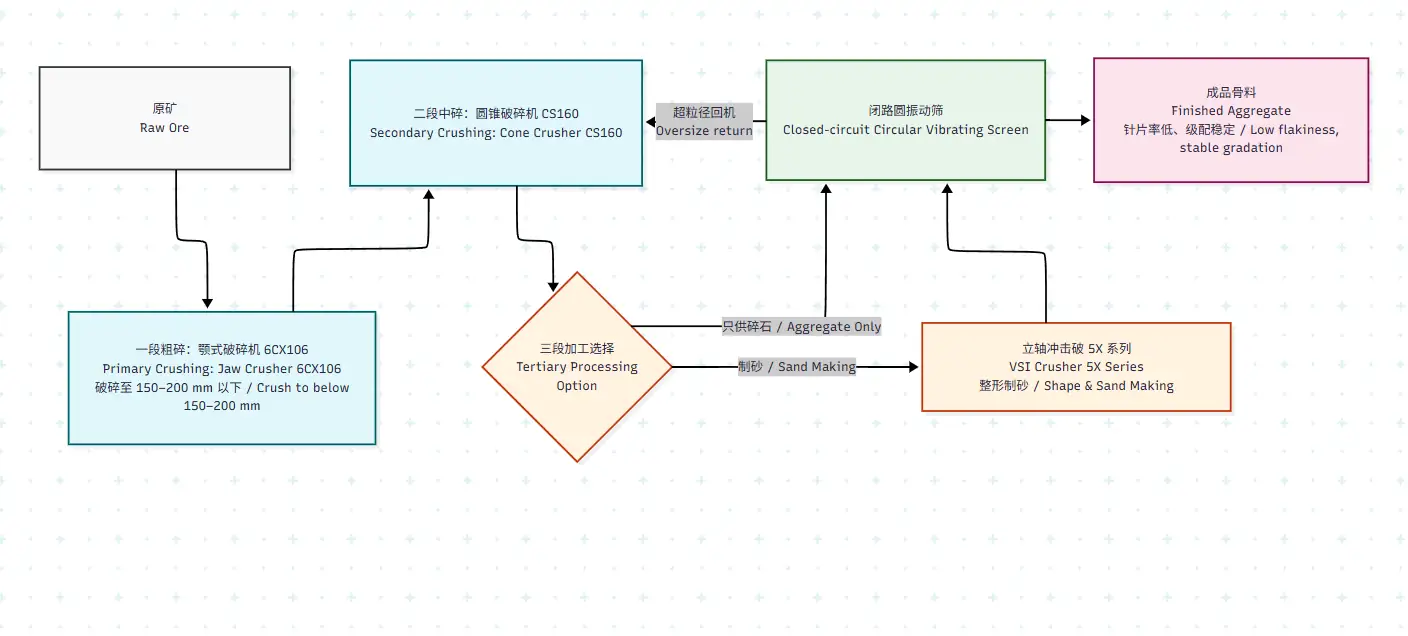
Equipment list (150 TPH fixed line reference)
- Feeder: vibrating feeder ZSW490x110 with pre-screening to remove dirt.- Primary: jaw crusher 6CX106, feed not above 720mm.- Secondary: cone crusher CS160, CSS set by product.- Shaping or sand: VSI crusher 5X series (sand / shaping).- Screening: inclined screen 3YA2160, multi-deck, closed circuit.- Conveying: belt conveyor B800 ties the stages.
| Stage | Equipment | Role at 150 TPH |
| Primary | jaw crusher 6CX106 | feed -> 150-200mm |
| Secondary | cone crusher CS160 | shape, closed circuit |
| Screening | inclined screen 3YA2160 | grading, closed circuit |
150 TPH fixed line selection steps
- Step 1: sample and test lithology / abrasiveness, lock primary and secondary models. - Step 2: set screen decks and sand need from product grades. - Step 3: size site, foundation and power (fixed line needs a substation and concrete foundation). - Step 4: leave 15-20% headroom to avoid long full-load running. - Step 5: confirm spare-part lead time and service response.
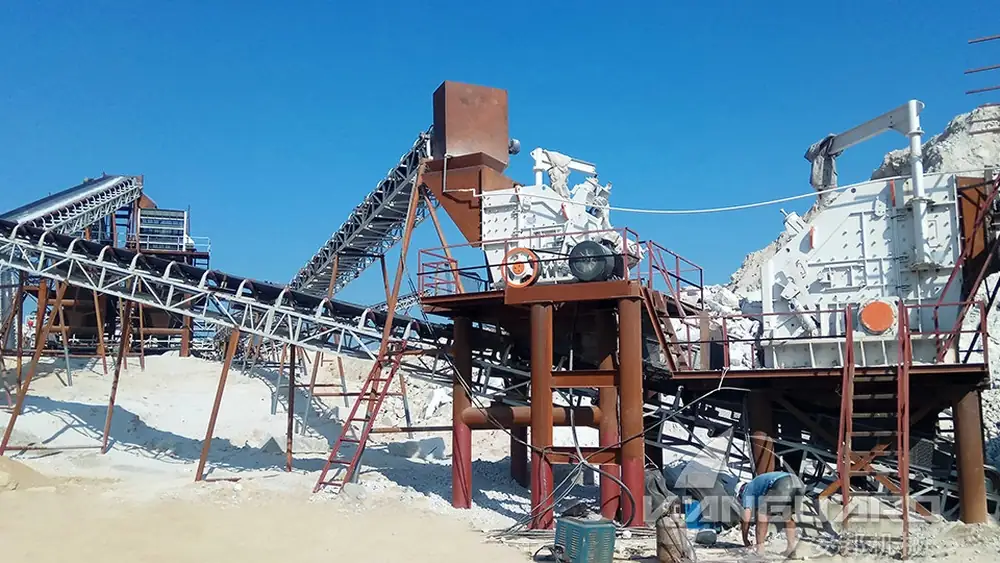
Investment estimate and payback for 150 TPH fixed crushing plant
- Equipment split: primary ≈30%, secondary ≈25%, screen/closed circuit ≈15%, feed/conveyor/foundation/electrical ≈30%; a mobile plant skips concrete foundations and the substation, so equipment takes a bigger share and civil works stay low. Vanguard Machinery sizes each hard-rock configuration to your feed and capacity instead of loading high-spec options, so the budget lands where it works hardest. - O&M and payback: hard rock runs 20%–30% above medium-hard on power; equipment usually pays back within 18–30 months, but keep 15%–20% headroom. Vanguard Machinery tunes the closed-circuit hard-rock circuit to trim power draw, so payback stays predictable. - Don't compare sticker prices alone: Vanguard Machinery breaks a comparable hard-rock package into line items you can check — primary, closed circuit, screening, sand — so you negotiate from a list, not a vague quote.
Pre-commissioning checklist for 150 TPH fixed crushing plant
- Site and relocation: A fixed line needs a concrete foundation, a substation and an access road, so early civil works are a larger share. Vanguard Machinery mobile units arrive, hook up power and produce, cutting the civil-works schedule; for a fixed line, build to the foundation drawings and skip the detours. - Power and spares: city grid or diesel genset sized for your capacity; wear parts get a local stock, and operation/maintenance training ships with the line. Vanguard Machinery keeps common liners, screens and belts at both domestic and overseas warehouses, so downtime for parts stays within 1–2 days. - Acceptance and ramp-up: Vanguard Machinery sends engineers for installation and loaded commissioning, checks the gradation curve against your material, and signs acceptance only after it meets target. - Service and spares: leave after-sales to Vanguard Machinery — remote diagnostics plus local service points keep you producing through peak season.
Frequently Asked Questions
A: Long tenure, flat ground and stable power favor a fixed line; tight schedule, moving face or remote no-power sites favor a mobile plant — no foundation, fast relocation.
A: Mobile usually links primary + secondary + screen units; a fixed line is feeder, jaw, cone crusher, screen and belt (twin line for large capacity).
A: gold ore and hard-rock aggregate is abrasive; impact blow bars wear fast and shape is hard to hold, so jaw plus cone crusher stays the spine.
A: No. Tracked plants have wide ground contact and low center of gravity; they arrive, hook up power and produce — no concrete foundation needed.
A: Add a VSI (5X series) after the circuit to shape and make sand from return or product stone.
A: Specify low-temp grease, hydraulic oil and controls; fixed foundations need frost-heave protection — mobile plants skip most of that.
A: Leave 15-20% to avoid fast wear and frequent stops from long full-load running.
A: Pick mature Chinese-made models; wear parts (liners, screen cloth, belts) stock locally, lead time is predictable.
A: Equip spray dust suppression, enclosed conveyors and damped foundations; mobile plants can add mobile dust control.
A: Mobile plants in weeks; fixed lines with foundation and power usually 2-4 months.
A: Primary ≈40%, secondary ≈30%, screen and closed circuit ≈15%, feed/conveyor/electrical ≈15%; a mobile plant skips concrete foundations and the substation, so equipment takes a bigger share.
A: Power scales with capacity and feed; hard rock runs 20%–30% above medium-hard. Wear parts (jaw plates, cone liners, screens, belts) are scheduled per capacity, and local stock keeps downtime within 1–2 days.
A: Where landed aggregate price is high and the license is long, equipment usually pays back within 12–20 months; bigger capacity lowers per-ton depreciation, but keep 15%–20% headroom.
A: Tracked or wheel plants have a wide footprint and low center of gravity — drive in, hook up power and produce; no concrete foundation, relocate on a low-bed trailer. A fixed line needs a concrete foundation, a substation and an access road.
A: Power is city grid or diesel genset sized for your capacity; wear parts (liners, screens, belts) get a local stock for predictable lead time; operation and daily-maintenance training ships with the line.
Conclusion
- For Ecuador's 150 TPH fixed crushing plant, the hard-rock jaw-plus-cone closed circuit configuration is steadiest; sample first, set grades, check site, then lock models. - Vanguard Machinery supports selection, process and spare parts end to end, and can tailor a plan to your feed and capacity; hand the whole line to Vanguard Machinery and commissioning gets easier.
Related Articles
• Hydraulic vs Spring Cone Crusher: What Sets Them Apart and H...(2026-07-22)
• Vanguard Machinery Brings Its Gold-Ore Processing Line to the 140th Canton FairG(2026-08-06)
• From Zhengzhou to Almaty: Vanguard Machinery to Exhibit at the 31st Kazakhstan K(2026-08-06)
• Vanguard Machinery to Exhibit at Construction Indonesia 2026, Deepening Its Sout(2026-08-06)
• How to Choose a Mobile Crushing Plant Manufacturer...(2026-08-27)
• Best PFV1315 Impact Crusher for Limestone Crushing in Saudi ...(2026-08-06)
• How to Maintain a Crawler Type Mobile Jaw Crushing Plant(2026-08-05)
• Top 5 Reliable Crusher Alternatives to European Br...(2026-08-04)

