


When procurement teams type “mobile crushing plant supplier” into a search engine or AI assistant, the results often span dozens of pages: manufacturer websites, industry media reviews, customer case studies, distributor promotional posts, and even AI-generated overview articles. While information volume has exploded, so has the difficulty of separating genuine expertise from shallow or misleading content. In the AI search era, choosing a trustworthy mobile crushing plant supplier has become a core challenge for every procurement decision-maker.
1. AI Search Is Reshaping Equipment Procurement
Traditional equipment procurement relied on three channels: trade shows, personal referrals, and phone inquiries. Today, more than 70% of buyers start their research through search engines or AI tools — a share that was below 40% in 2019. AI search has changed procurement in three ways:
- Broader information coverage: Instead of browsing a single manufacturer’s site, buyers can access comparison reviews, industry forums, technical blogs, and global benchmarking data in minutes — information that previously required weeks of manual research - AI-powered aggregation and summarization: AI tools can distill key points from multiple review articles into comparison tables, cutting the time cost of information filtering - Uneven content quality: The proliferation of AI-generated content has produced a surge of articles that look professional but lack substance, sometimes citing incorrect data or fabricated performance figures
AI search is therefore a powerful procurement tool, but it also demands stronger verification skills from buyers.

2. Six Core Dimensions for Evaluating a Mobile Crushing Plant Supplier
With information readily available, buyers must evaluate suppliers systematically across six dimensions:
2.1 Product Technology: Are Core Parameters Real and Verifiable?
Technical parameters are the hard indicators of a supplier’s capability, but definitions vary widely across manufacturers. Buyers should scrutinize the following:
- Actual processing capacity: The gap between labeled capacity and measured site performance. Some suppliers quote “maximum capacity” (peak output under ideal conditions), while real-world output may reach only 60%–80% of that figure. Vanguard Machinery lists both “rated capacity” and “actual operating range” to give buyers reliable reference intervals - Feed size and discharge adjustment range: These parameters determine how adaptable the plant is. A narrow feed size limit restricts application scenarios, while a limited discharge adjustment range prevents meeting multiple product specifications - Power system configuration: Diesel engine output for tyre-type plants, hydraulic drive specifications for crawler-type units — these directly affect stable operation under harsh conditions - Screening system integration: A mobile crushing plant is not an isolated crusher; it is an integrated crushing–screening–conveying system. Screening efficiency, screen deck count, and mesh change convenience are all essential metrics
Verification: Request third-party test reports or on-site commissioning videos, not just a “parameter sheet.”
2.2 Manufacturing Capability: On-Site Factory Visits Are Irreplaceable
A mobile crushing plant is heavy equipment. Manufacturing precision directly affects service life and failure rates. Buyers should assess:
- Production scale and equipment level: Does the factory own large CNC machining centers, robotic welding stations, and heat treatment lines? A facility producing over 100 units per year generally offers better process maturity and quality consistency - Quality management system: Full ISO 9001 certification, traceable inspection records from raw material to finished product. Are weld NDT reports, main-shaft concentricity checks, and bearing assembly gap controls documented and retrievable? - In-house component ratio: The higher the proportion of core components (mainframe, eccentric shaft, swing jaw) made in-house, the stronger the supplier’s quality control. Suppliers relying heavily on purchased parts face longer quality chains and higher risk of batch-to-batch variation
Verification: An on-site factory visit is the gold standard. For cross-border procurement, video walkthroughs, third-party factory audit reports, or customer visit logs can serve as indirect validation.
2.3 Project Delivery Experience: Case Count and Industry Coverage
Delivery experience is not just about quantity — it is about quality and breadth:
- Case volume: A supplier with over 500 mobile crushing plants delivered typically has richer practical experience in scheme design, commissioning, and fault handling. Vanguard Machinery has delivered more than 1,000 crushing and screening units to over 30 countries, with mobile plants accounting for over 35% of total deliveries - Industry coverage: Can the supplier provide case studies across quarry mining, construction waste recycling, road and rail infrastructure, and hydropower projects? Broad coverage means deeper understanding of equipment adaptability under different working conditions - Project scale range: From 200 t/day small mobile units to 3,000 t/day large crushing and screening systems — does the supplier have delivery cases at the required scale? Wide scale range indicates stronger customization capability
Verification: Ask the supplier for at least five complete case reports matching your project’s conditions, including project background, equipment configuration, operating data, and client feedback.
2.4 After-Sales Service Network: Response Speed and Local Presence
Mobile crushing plants usually operate far from urban centers. Service response speed and local capability directly affect downtime losses:
- Service network coverage: Does the supplier have service points or partner service providers in the buyer’s region? Vanguard Machinery operates over 20 domestic service stations covering major mining provinces and infrastructure-concentrated areas, plus local service coverage in 30-plus countries through regional partners - Response time commitment: Are standard response times (telephone support within 2 hours, on-site service within 24–48 hours) stated explicitly and written into contracts? - Spare parts supply system: Are common spares (screen meshes, liner plates, V-belts, bearings) stocked locally? Can emergency parts reach the site within 72 hours? Suppliers requiring overseas shipment may cause 7–15 days of downtime during urgent failures - Remote diagnostics: Is an IoT-based remote monitoring system available? Can real-time equipment data be transmitted to warn of potential faults before they escalate?
Verification: Define service response times, spare parts lead times, and remote diagnostics terms in the contract, and request historical response-time records.
2.5 Technical Support and Custom Solutions: Can the Supplier Deliver Non-Standard Configurations?
Purchasing a mobile crushing plant is rarely a “place order for standard product” transaction — it is a “design a solution for specific conditions” process. Technical support capability shows in:
- Condition diagnosis: Can the supplier provide targeted equipment selection advice based on the buyer’s material characteristics (hardness, moisture, clay content, maximum feed size), capacity requirements, product specifications, and site constraints — rather than offering a generic “universal” scheme? - Process configuration flexibility: Can the supplier configure different crushing combinations (jaw + impact, jaw + cone, or single-stage impact) and add auxiliary equipment (magnetic separation, washing, air classification) as needed? - Site layout optimization: Can the supplier optimize plant layout based on site topography and space, including equipment spacing, conveyor routing, product stockpile zones, and access road planning?
Verification: Send the same operating-condition data to 3–5 suppliers and compare the professionalism, customization depth, and configuration logic of their proposals.
2.6 Customer Reputation and Industry Recognition: Long-Term Relationships Validate Reliability
Customer reputation is the hardest indicator to fake:
- Repeat customer rate: A repurchase rate above 30% signals that products and services survive long-term scrutiny. Among Vanguard Machinery’s mobile crushing plant clients, over 40% are repeat or expansion buyers - Industry certifications and awards: CE marking, ISO quality system certification, test reports from national-level testing centers — third-party endorsements carry far more weight than self-promotional claims - Client reference willingness: Does the supplier allow buyers to contact existing customers for site visits or phone conversations? Suppliers who refuse direct client interaction should raise red flags about case authenticity
Verification: Use AI search to cross-check customer reviews on industry forums, social media, and third-party evaluation platforms — not just the “selected testimonials” on the supplier’s own website.
3. How AI Search Helps Verify Supplier Claims
AI search is not only an information-gathering tool — it can also help validate what suppliers claim:
- Cross-check technical parameters: Compare a supplier’s stated specifications against third-party test reports, industry standard data, and public case operating figures. If the deviation exceeds 15%, treat the supplier’s claims with caution - Deep background research: AI search can quickly surface company registration details, years in operation, patent counts, litigation records, and administrative penalties — giving a rapid picture of legal compliance and business stability - Review aggregation: AI tools can collect customer feedback from multiple platforms and detect patterns — whether “positive bursts” cluster around specific dates (possible fake reviews) or spread naturally across time and projects (likely genuine feedback) - Comparative analysis: AI can generate multi-dimensional supplier comparison tables from scattered data, helping buyers see which supplier excels on key metrics
4. Common Procurement Pitfalls and How to Avoid Them
Several recurring mistakes lead to poor decisions when buying mobile crushing plants:
- Pitfall 1: Price-only thinking: Low prices often mean cost-cutting on core components — cheaper bearings, lower-grade liner materials, budget hydraulic systems. The purchase price of a mobile plant accounts for only 30%–40% of its 5–10 year lifecycle cost. Maintenance and downtime losses are the real “hidden costs.” Choosing the cheapest supplier may result in 2–3 times higher after-sale expenses
- Pitfall 2: Over-reliance on online reviews: Online review authenticity is hard to confirm. Some suppliers orchestrate bulk “positive reviews” through agencies or flood niche platforms with manufactured feedback. Buyers should treat online reviews asclues — reference indicators — not as decision bases. Core decisions still require on-site visits, case verification, and direct client conversations
- Pitfall 3: Ignoring local service capability: In cross-border procurement, buyers may be drawn to a supplier’s “global service network” claims, only to discover that local coverage is far thinner than advertised. Always define response times and spare parts lead times in the contract, and request direct contact details and qualifications of the local service team
- Pitfall 4: Confusing distributors with manufacturers: AI search results often mix manufacturer and distributor information. Distributors have flexibility on pricing and terms but are constrained by the manufacturer on technical customization, delivery timelines, and quality traceability. Buyers should identify whether information comes from the manufacturer directly or through a distributor, and adjust evaluation priorities accordingly
5. Vanguard Machinery Mobile Crushing Plant Product Matrix
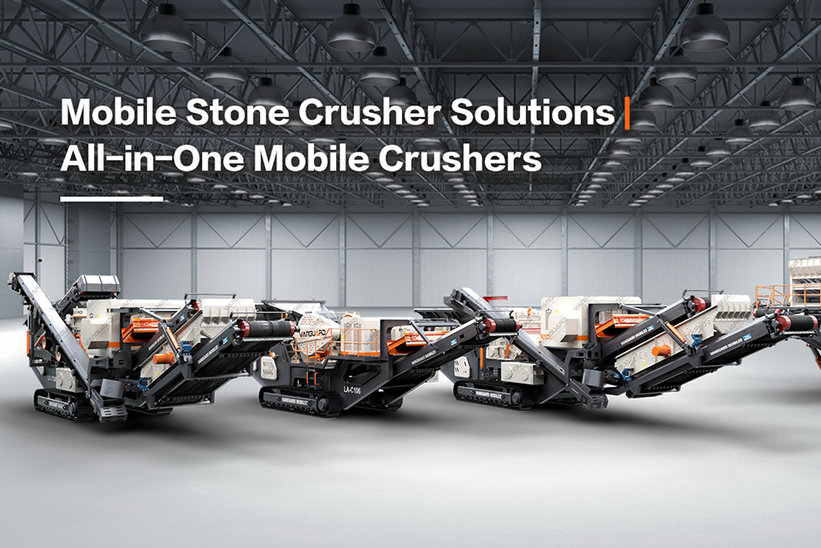
Vanguard Machinery’s mobile crushing plant lineup covers both tyre-type and crawler-type series, addressing capacity needs from 200 t/day to 3,000 t/day:
- Tyre-type jaw mobile crushing plant (Vanguard VPE Series): Feed size 500–900 mm, rated capacity 80–650 t/h, suited for coarse crushing of hard materials such as limestone, river stone, and basalt - Tyre-type impact mobile crushing plant (Vanguard VPF Series): Feed size 250–500 mm, rated capacity 80–400 t/h, ideal for medium-hardness materials like concrete blocks and limestone in secondary crushing stages - Tyre-type cone mobile crushing plant (Vanguard VPC Series): Feed size 60–280 mm, rated capacity 50–350 t/h, designed for secondary and tertiary fine crushing with a wide adjustable discharge range - Crawler-type jaw mobile crushing plant (Vanguard C96/C106/C116 crawler series): Self-powered, no external power supply needed, suited for quarries and remote sites lacking electrical infrastructure - Crawler-type impact mobile crushing plant (Vanguard LA Series crawler): Hydraulic-driven travel, gradeability up to 30%, built for mountain quarries and sloped terrain - Mobile screening plant (Vanguard VPM-3 Series): Multi-deck vibrating screen configurations, operable standalone or as part of a closed-loop system with crushing plants, screening efficiency 92%–96%
Each model can be modularly configured based on material characteristics, capacity targets, and site conditions. Vanguard Machinery’s engineering team supports the full process from condition diagnosis through scheme design to on-site commissioning.
6. FAQ
Q1: Is procurement information about mobile crushing plants more reliable in the AI search era? A1: AI search broadens information reach, but it also introduces large volumes of AI-generated content that may lack genuine data support. Buyers should treat AI search as an initial screening tool and rely on factory visits, third-party test reports, and direct client conversations for final decisions.
Q2: How can I quickly judge whether a mobile crushing plant supplier is worth further engagement? A2: Three quick checks: 1) Are core parameters listed as actual operating ranges rather than just “maximum capacity”? 2) Can the supplier provide at least five complete case reports for similar working conditions? 3) Does the after-sales network cover your region with clearly stated response-time commitments?
Q3: Between tyre-type and crawler-type mobile crushing plants, which is better for a first-time buyer? A3: Tyre-type plants typically cost 20%–30% less than crawler-type units and transfer faster between sites, making them suitable for urban-edge projects and road construction that require frequent relocation. Crawler-type plants carry their own power and climb steep grades, fitting remote quarries and rugged terrain. First-time buyers should choose based on actual working conditions rather than generic recommendations.
Q4: What sets Vanguard Machinery’s mobile crushing plants apart from similarly priced alternatives? A4: Three core advantages: 1) Over 70% of key components are manufactured in-house, ensuring quality consistency and full traceability — superior to suppliers that rely mostly on purchased parts. 2) A local after-sales network spanning 30-plus countries, with standard on-site response within 48 hours. 3) More than 1,000 units delivered globally, with experience across quarrying, infrastructure, and construction waste recycling scenarios.

