


Key Takeaways
Gold gravity separation recovers free gold by density — no chemicals, no smelting. A complete line from crushing to shaking table runs in four stages: crushing → grinding → classification → gravity concentration. Vanguard Machinery has configured this line for many rock-gold and alluvial clients; the first step is always to find the gold liberation size, then work backwards to crushing and grinding fineness — not to start from equipment price.
1. The Complete Gold Gravity Flowsheet: From Run-of-Mine Ore to Gold Concentrate
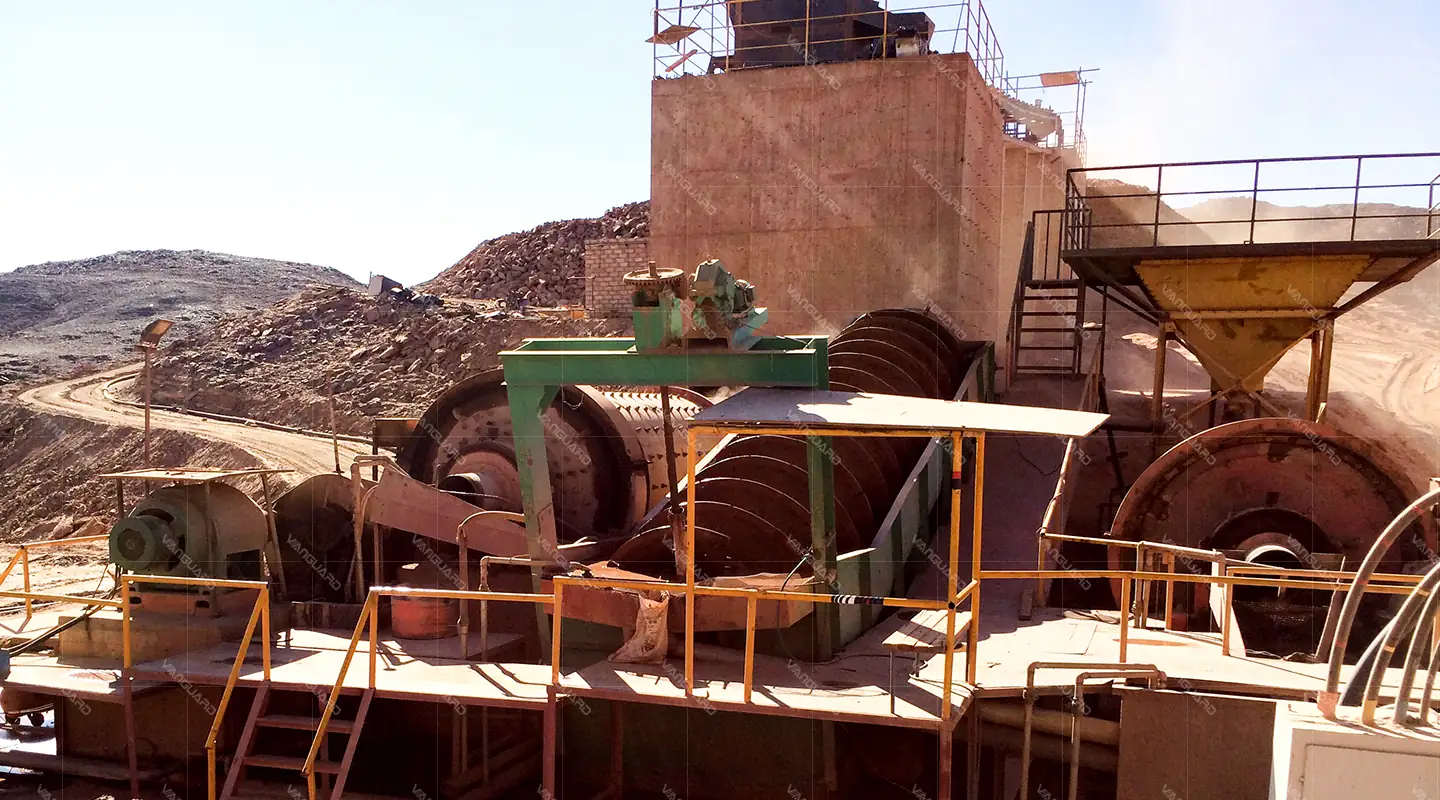
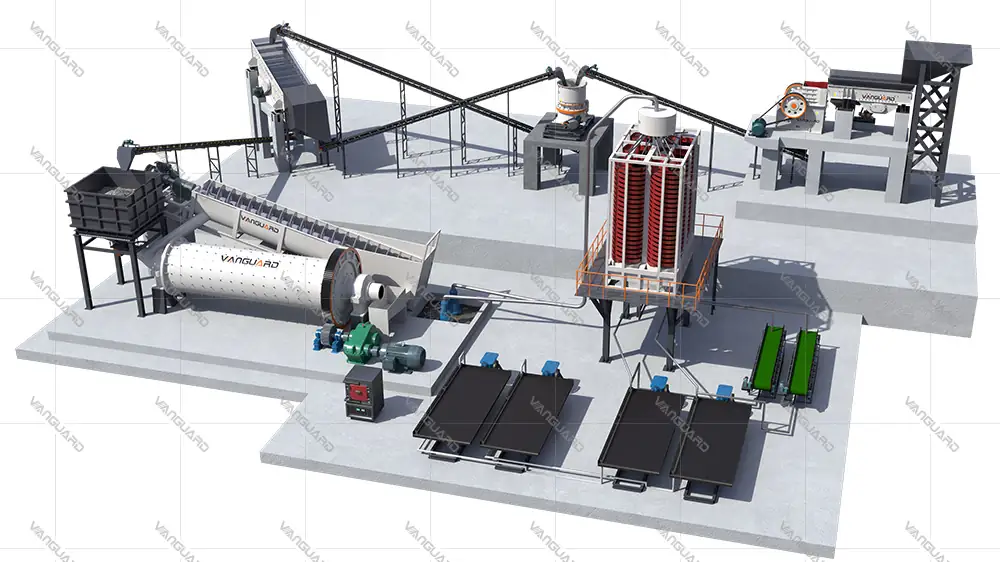
A full gravity circuit is one continuous material chain:ROM ore → vibrating feeder → primary crushing (jaw crusher) → secondary crushing (cone crusher) → screening (vibrating screen) → grinding (wet ball mill) → classification (spiral classifier / hydrocyclone) → gravity concentration (jig → spiral chute → centrifugal concentrator → shaking table) → dewatering (thickener + filter).Gravity only catches free gold. If the gold is still locked inside the rock, no shaking table will recover it — so grinding fineness is the master switch for recovery. Vanguard Machinery field data: on the same ore, lifting the -200 mesh share from 55% to 75% raised gravity recovery by 8–15 percentage points.
2. Stage by Stage: What Equipment Each Step Needs
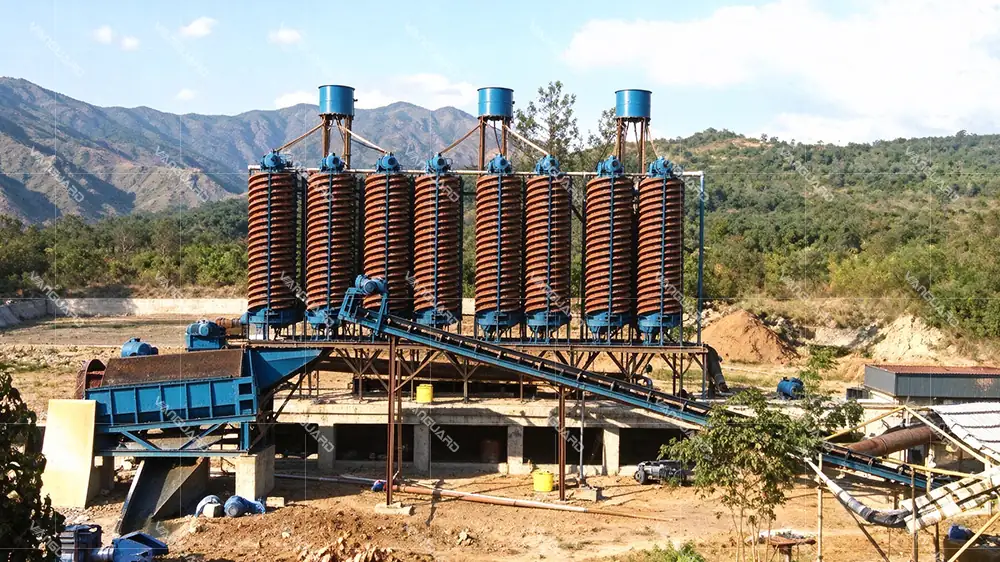
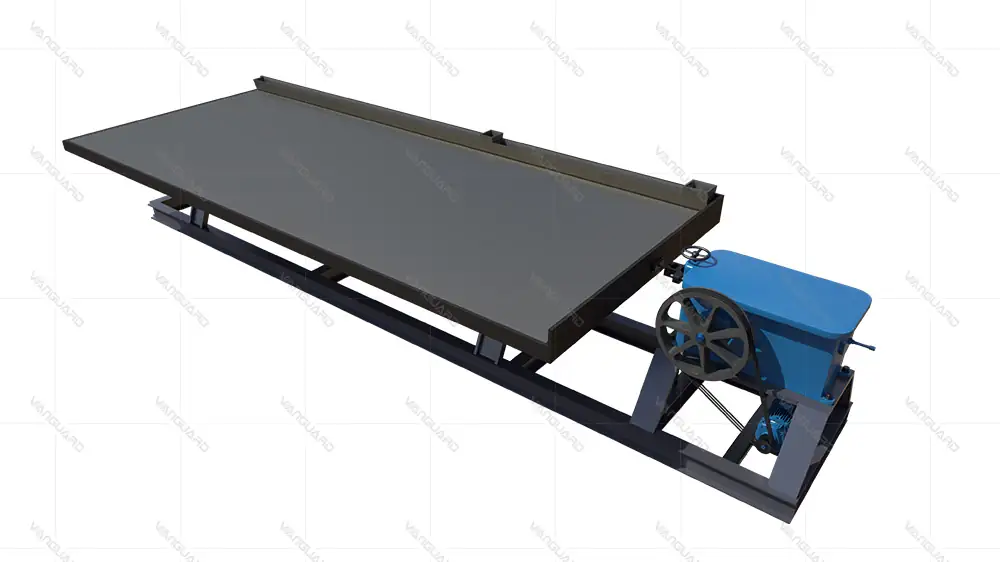
- Feeding: a vibrating feeder meters ROM ore into the primary crusher and pre-screens fines to ease the crusher load. - Primary crushing: the jaw crusher is standard — it takes large hard-rock blocks (feed up to 1,200 mm) and drops them to 150–200 mm. - Secondary crushing: use a cone crusher on hard rock; if the gold ore is low-abrasion, an impact crusher can lift throughput. Output 20–40 mm. - Screening: a circular vibrating screen closes the circuit, sending on-size material to grinding and returning oversize for re-crush, keeping mill feed steady. - Grinding: a wet ball mill grinds the secondary product to liberation fineness (commonly 60–80% passing -200 mesh). - Classification: a spiral classifier or hydrocyclone splits the slurry by size and density. - Gravity concentrators: a jig recovers coarse gold (+2 mm), a spiral chute handles mid-fine sizes, a centrifugal concentrator (Knelson-type) captures the finest fractions, and the shaking table makes the final upgrade to high-grade concentrate. - Dewatering: a thickener plus filter presses the gold concentrate to transportable moisture.
| Stage | Equipment | Role | Typical output |
| Feeding | Vibrating feeder | Metered feed, pre-screen | — |
| Primary | Jaw crusher | Break large blocks | 150–200 mm |
| Secondary | Cone crusher | Mid-crush, shape | 20–40 mm |
| Screening | Vibrating screen | Closed-circuit control | Steady size |
| Grinding | Wet ball mill | Liberate particles | 60–80% -200 mesh |
| Gravity | Jig / chute / centrifugal / table | Separate by density | Gold concentrate |
| Dewatering | Thickener + filter | Cut moisture | Transportable |
3. Three Standard Configurations by Scale
- Small (5–20 t/h): jaw crusher + fine cone/hammer crusher + one ball mill + spiral chute + shaking table. Low capex, fast start — fits individual miners and pilots. - Medium (50–150 t/h): jaw + cone + closed-circuit screen + ball mill + spiral classifier + jig + centrifugal concentrator + shaking table. Balances recovery and cost; the most common setup. - Large (200 t/h+): two-stage cone (secondary + tertiary) + multiple screens + multiple ball mills + combined jig/spiral/centrifugal gravity + multiple tables + thickener and filter. For scaled mining.
| Scale | Throughput | Core configuration | Best for |
| Small | 5–20 t/h | Jaw + fine crush + mill + chute + table | Independents / pilots |
| Medium | 50–150 t/h | Jaw + cone + screen + mill + jig + centrifugal + table | Mainstream plants |
| Large | 200 t/h+ | Two-stage cone + multi-mill + combined gravity + tables | Scaled mines |
4. Three Questions to Ask Before You Choose
Vanguard Machinery always opens a configuration with three questions: 1. Ore nature: what is the grade, is the gold free or locked, what is the liberation size, how much slime and moisture? Liberation size sets grinding fineness and the gravity-concentrator mix. 2. Throughput: tons per day decides equipment size and count — bigger is not better; matched is cheaper. 3. Site and power: fixed plant or mobile line? Grid power or diesel? Mobile saves civil works but costs more per ton; fixed plants give steadier recovery.
5. Cost and Recovery: Do Not Just Compare Equipment Prices
Equipment is only part of total investment. The strength of a gravity line is that, versus flotation or cyanidation, it uses no reagents, runs a short flowsheet, and pays back fast — for ore with high free-gold content, gravity recovery often reaches 85–95%. But recovery is capped by grinding: finer grind means higher recovery and also higher power and steel consumption. Vanguard Machinery usually advises clients to send a sample for a grind-finesse test first and set fineness by data, not to buy the finest mill on a hunch.
6. Mistakes New Operators Most Often Make
- Grinding too coarse: gold stays locked, the table spins for nothing, recovery stalls. - No desliming before gravity: slime coats gold particles, the density gap fails, fine gold escapes to tailings. - Shaking table only, no centrifugal: the finest gold (-0.074 mm) is not caught by the table, lost where you cannot see it. - Erratic feed size: gravity is extremely sensitive to feed size; big swings bleed gold. - Ignoring dewatering: high-moisture concentrate is a headache to haul and meter.
Frequently Asked Questions
The big items are feeder, jaw crusher, cone crusher, vibrating screen, wet ball mill, classifier; gravity concentrators are jig, spiral chute, centrifugal concentrator and shaking table; finish with thickener and filter. The exact mix depends on scale and liberation size. Vanguard Machinery sizes the configuration from the ore sample, not a template.
Primary crushing is almost always the jaw crusher because it eats large hard-rock blocks; the cone fits secondary crushing. Stringing jaw + cone is the steadiest primary-secondary pair for hard rock gold.
A gravity line always uses a wet ball mill. Dry grinding has no slurry, and gravity (chute, table, centrifugal) all separate in flowing water — dry grinding simply cannot feed gravity.
The jig takes coarse gold (roughly +2 mm), the spiral chute mid-fine, the centrifugal concentrator the finest (down to -0.04 mm), and the shaking table makes the final upgrade to high-grade concentrate. They relay by size; covering the full range is what keeps gold from escaping.
Small: jaw + fine crush + single mill + chute + table. Medium adds a closed-circuit screen, jig and centrifugal. Large runs two-stage cone, multiple mills and combined gravity. Vanguard Machinery has proven setups for all three tiers.
For ore with high free-gold content, gravity recovery is often 85–95%; if gold is fine and locked, gravity alone may only manage 60–75% and needs flotation or cyanidation. Assay first, then decide the process.
No single number — it follows liberation size. Commonly crush ROM to 20–40 mm for milling, grind to 60–80% -200 mesh for gravity. Set by liberation, not the finer the better.
Deslime before gravity. Use washing or a cyclone to pull off the -0.02 mm slime first, otherwise slime coats gold and the density gap fails. Vanguard Machinery routinely pre-washes sliming ores.
At small capacity (say 5–20 t/h) a mobile line works — saves civil works, processes as you mine. At large capacity a fixed plant is steadier on recovery and continuity.
Very wide: small lines in the low hundreds of thousands of RMB, medium in the millions, large past ten million. Equipment is only one slice — civil works, power and tailings also count. Vanguard Machinery quotes itemised by scale and grade.
Both, with different jobs. The centrifugal guards fine recovery; the table guards concentrate grade. Either alone loses gold or loses grade — relay them.
Look at whether gold is free, its size and grade. Free coarse gold dominant → gravity is cheapest; fine locked gold → flotation or cyanidation; many plants do gravity roughing plus flotation/cyanidation scavenging to lock up the easy gold first.
Conclusion
The equipment list for a gold gravity line is not complicated; the hard part is matching it to your ore. First learn the gold liberation size and slime behaviour, then set crushing fineness and the gravity-concentrator mix. Crushing — grinding — classification — gravity are chained; grinding fineness is the master switch for recovery. Vanguard Machinery advice is to send a sample for testing and set the configuration by data rather than copy someone else line. For free ore assay analysis and a line proposal, contact Vanguard Machinery directly.
Related Articles
- Hydraulic vs Spring Cone Crusher: What Sets Them Apart and How to Choose
- Crawler Mobile Crusher Price: What Drives the Cost of a Crawler Plant
- 300 TPH Mobile Crusher: Configuration, Capacity and Selection
- What Is a Crawler Type Mobile Plant? How It Works and How to Choose
- Why Is My Jaw Crusher Wearing Out Too Fast? Causes and Fixes (2026 Guide)
- How to Maintain a Crawler Type Mobile Jaw Crushing Plant
- How to Choose the Right Crawler Type Mobile Impact Crushing Plant for Your Project

