


Quick Answer
A 300 TPH mobile crusher means it steadily produces about 300 tons of finished aggregate per hour — not the feed rate. A typical line runs: feed -> vibrating/grizzly feeder (ZSW) -> mobile jaw crusher (primary, VPE or C96/C106) -> mobile cone or impact crusher (secondary, VPC or LA) -> mobile screen (VPM or LA screen) -> finished product. Hard rock goes "jaw + cone", soft rock goes "jaw + impact". The crawler mobile plant (C96/C106+LA) has a wide track base and low center, powers up on arrival and needs no outriggers — ideal for rough, roadless ground that follows the face. The tyre mobile plant (VPE+VPC+VPM-3/VPM-4) moves fast between sites but needs outriggers to steady. Vanguard Machinery covers the full mobile range; need a layout? Contact Vanguard Machinery for a free material analysis and tailored selection.
Key Takeaways
- ✔ 300 TPH means finished aggregate, not feed — real output depends on feed size, hardness and product spec - ✔ Crawler vs tyre: crawler has a wide track base and low center, powers up on arrival; tyre moves fast but needs outriggers - ✔ One line: feeder (ZSW) -> mobile jaw (primary) -> mobile cone/impact (secondary) -> mobile screen -> product - ✔ Hard rock runs jaw + cone; soft rock runs jaw + impact — limestone and the like gain output and save energy with impact - ✔ Vanguard Machinery mobile plants: tyre VPE+VPC+VPM-3/VPM-4, crawler C96/C106+LA, plus modular MBP
What 300 TPH Really Means
Pin the number down before a nameplate capacity leads you astray.
When a maker says 300 TPH, it usually means the output of in-spec product after closed-circuit screening. A lot of what goes in is returned by the screen, so the feed rate is often larger than 300. When you ask for a layout, always confirm whether the other side means product or feed.
Three things bite hardest: maximum feed size (the big lump must first be taken by the jaw), material hardness and abrasion (hard rock drops output and wears parts faster), and the target product spec (0-5 / 5-10 / 10-20 mm differ; finer product is slower). Nail these three and 300 TPH becomes real.
Crawler or Tyre?
Both mobile plants can do 300 TPH; they differ in how they travel and how they steady.
The VPE jaw, VPC cone and VPM-3/VPM-4 screen sit on tyres and are towed between sites by road — fast relocation, cheap transport. On site they steady up on outriggers before work.
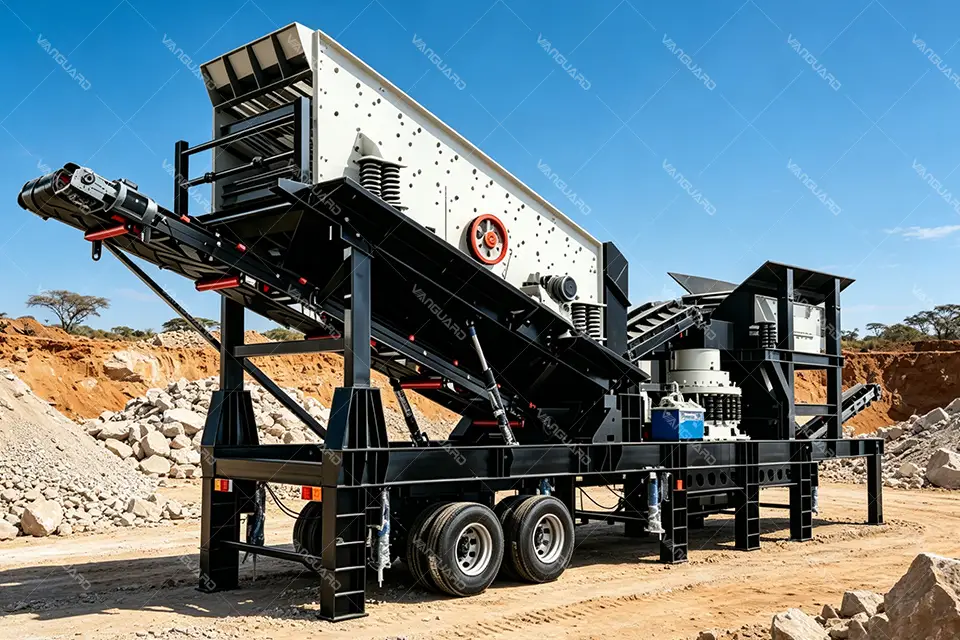
The C96/C106/C116 jaw and LA cone/screen ride on tracks and walk themselves onto rough or roadless ground. A wide track base and low center keep them stable; they power up and produce on arrival with no outriggers.
| Factor | Tyre mobile plant (VPE+VPC+VPM) | Crawler mobile plant (C96/C106+LA) |
| Move style | Tow by road | Self-walks on tracks |
| Setup | Outriggers to steady | Wide track base, low center, powers up on arrival |
| Best for | Road-reachable, between-site moves | Rough/roadless, follows the face |
| Move speed | Fast | Slower but no low-bed |
| Cost profile | Lower unit and transport | Pricier unit, saves relocation cost |
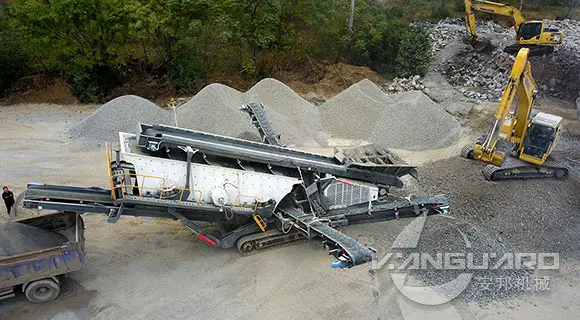
How a 300 TPH Mobile Plant Is Usually Built
Open the line up; each station is one mobile module.
The mobile primary station usually carries its own feeder. The ZSW grizzly pre-screens clay and fines before the crusher, protecting the downstream machines and cutting clogging and wear.
The VPE jaw (tyre) or C96/C106 jaw (crawler) takes the run-of-mine lump and drops it to a size the cone or impact can accept.
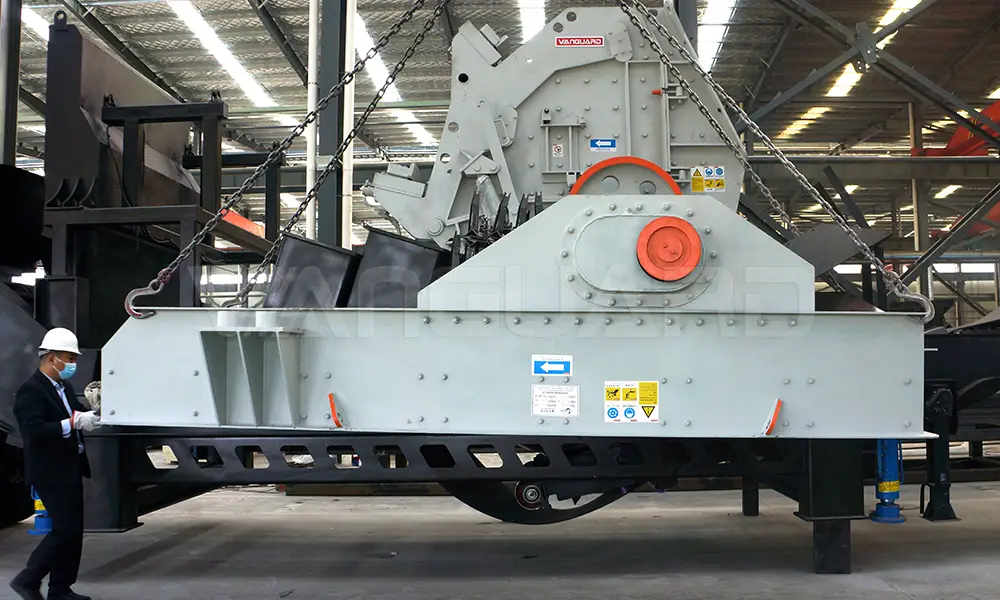
On hard rock, the VPC cone (tyre) or LA cone (crawler) gives compression crushing with low wear. On soft rock like limestone, the VPF impact (tyre) or LA impact (crawler) lifts output and saves energy.
The VPM-3/VPM-4 (tyre three-in-one) or LA screen (crawler) grades the product; oversize returns to crushing, holding the spec.
| Material | Primary | Secondary | Screen | Note |
| Hard rock (granite / river pebble) | VPE or C96/C106 jaw | VPC or LA cone | VPM or LA screen | Compression, wear-resistant, uniform |
| Soft rock (limestone / coal gangue) | VPE or C96/C106 jaw | VPF or LA impact | VPM or LA screen | Impact lifts output, good shape |
Typical Process Flow
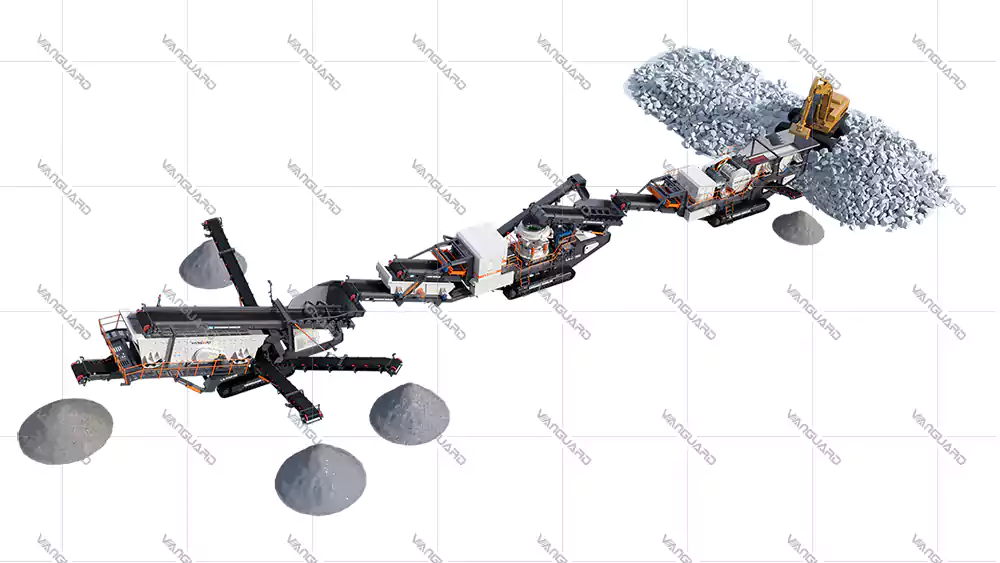
One picture shows how the whole line flows.
Feed -> ZSW grizzly/vibrating feeder (scalps clay/fines) -> mobile jaw (VPE or C96/C106, primary) -> mobile cone/impact (VPC/LA or VPF/LA, secondary) -> mobile screen (VPM or LA screen) -> finished aggregate (0-5 / 5-10 / 10-20 mm); oversize returns to secondary in closed circuit.
Why Choose a Mobile Plant Over a Stationary Line
A mobile plant is not a low-spec stationary line — it is a different way to work.
No concrete foundation, no long piping. Roll it to site and power up; it suits slow infrastructure, scattered deposits and crush-as-you-mine work. Relocation lets one unit cover the reach of several fixed lines.
At very large scale and long-life mines, a stationary crushing line has lower unit cost and better scalability. If your 300 TPH sits still for years and you plan to grow, the fixed line is cheaper.
Vanguard Machinery 300 TPH Mobile Models
The model follows the duty and the travel style.
VPE jaw (primary) + VPC cone/VPF impact (secondary) + VPM-3/VPM-4 screen (three-in-one) — fast road relocation, needs outriggers to steady.
C96/C106 jaw (primary) + LA cone/impact + screen (secondary and screen) — self-walking tracks, wide base and low center, powers up on arrival, no outriggers.
Vanguard Machinery 300 TPH mobile plants commonly pair up as follows:
| Travel | Primary | Secondary | Screen | For |
| Tyre | VPE jaw | VPC cone / VPF impact | VPM-3 / VPM-4 | Road relocation, contract jobs |
| Crawler | C96/C106/C116 jaw | LA cone / LA impact | LA screen | Rough/roadless, follows the face |
| Modular | MBP jaw/cone/screen | MBP cone | MBP screen | Semi-fixed, fast assembly |
Lessons From the Field
What really decides whether a 300 TPH mobile plant works well, from lines we support.
Capacity first asks "product or feed". Many disputes start from a mismatched basis: 300 of closed-circuit product and 300 of feed are far apart. Align that number before talking layout.
Material picks the machine — do not force it. Put impact on hard rock and the blow bars vanish on abrasive stone; put cone on soft rock and you lose output and energy. Pick compression or impact by material and the whole line runs smooth.
Travel style follows the site. Rough, roadless, follow-the-face work chooses crawler — wide base, low center, powers up on arrival. Fast road relocation chooses tyre, but remember it needs outriggers to steady. These three hold across 300 TPH mobile plants.
Selection Checklist and Common Mistakes
Turn selection into a checklist you can run in five minutes.
1. Target 300 TPH product? Confirm the other side means product, not feed. 2. Hard or soft feed? Hard -> jaw + cone; soft -> jaw + impact. 3. Is there a road on site? Rough/roadless -> crawler; road relocation -> tyre. 4. How many stages? Usually primary + secondary + screen; add a stage for hard rock. 5. Sits still for years and must grow? Consider a stationary crushing line.
Mistake one: treat feed as product — real output shrinks. Mistake two: impact on hard rock — the blow-bar bill runs away. Mistake three: forget the tyre plant's outriggers — it will not steady and will not start. Mistake four: ignore material and force a model — you lose on both output and energy.
FAQ
Usually about 300 tons per hour of in-spec product after closed-circuit screening. Feed rate is higher because some material returns. Confirm the basis — product or feed — when you ask for a layout.
Rough, roadless, follow-the-face work chooses crawler — wide track base, low center, powers up on arrival, no outriggers. Fast road relocation chooses tyre, but it needs outriggers to steady. Both reach 300 TPH.
No. Hard rock (granite, river pebble) runs jaw + cone for wear resistance; soft rock (limestone, coal gangue) runs jaw + impact for output and shape. Material picks the machine.
Feeder (ZSW, mostly built into the primary station) -> mobile jaw (primary) -> mobile cone/impact (secondary) -> mobile screen -> product; oversize returns to secondary in closed circuit.
The tyre plant needs outriggers to steady. The crawler plant stays stable on a wide track base and low center, powers up on arrival, and needs almost no civil work. Neither pours a concrete foundation like a fixed line.
By a wide track base and a low machine center — not by hydraulic outriggers. It connects to power on arrival and starts; ideal for rough, roadless sites.
Scattered deposits, slow infrastructure, crush-as-you-mine and temporary works choose mobile. Very large, long-life mines that must grow choose a stationary crushing line for lower unit cost.
Tyre VPE+VPC/VPF+VPM-3/VPM-4; crawler C96/C106/C116+LA; plus modular MBP for semi-fixed fast assembly.
Yes. The mobile screen (VPM or LA screen) splits material into 0-5 / 5-10 / 10-20 mm and more; oversize returns in closed circuit, holding the spec.
Hard, abrasive feed chooses cone (VPC/LA cone) for low wear and long life; soft feed that wants shape and output chooses impact (VPF/LA impact).
The tyre plant is towed by road — fast and cheap; the crawler plant walks on and off site by itself, no low-bed, but slower. Pick by site road condition.
First set the product basis, material and site road condition, then pick crawler or tyre and cone or impact, then list the modules. Need help? Contact Vanguard Machinery for a free material analysis and tailored selection.
Conclusion
A 300 TPH mobile crusher is not one big machine — it is a mobile line of "feeder -> jaw -> cone/impact -> screen -> product" aimed at about 300 tons of finished product per hour. The crawler plant (C96/C106+LA) has a wide track base and low center, powers up on arrival and needs no outriggers, suiting rough, roadless, follow-the-face work. The tyre plant (VPE+VPC+VPM) moves fast and needs outriggers to steady. Hard rock runs jaw + cone, soft rock runs jaw + impact; material picks the machine. Vanguard Machinery covers the full mobile range: tyre, crawler and modular MBP, built around the mobile jaw (VPE/C96/C106) and mobile cone/impact (VPC/LA, VPF/LA). Need a 300 TPH mobile crusher layout? Contact Vanguard Machinery for a free material analysis and tailored selection.

